
Year 11 Geometry Main Lesson. Ahead of their Time: An Introduction to the Projective Geometry Main Lesson
By Neil Anderson - College of Teacher’s Chair, English, Maths and Geography Teacher
Year 11 Geometry Main Lesson
Ahead of their Time: An Introduction to the Projective Geometry Main Lesson
By Neil Anderson
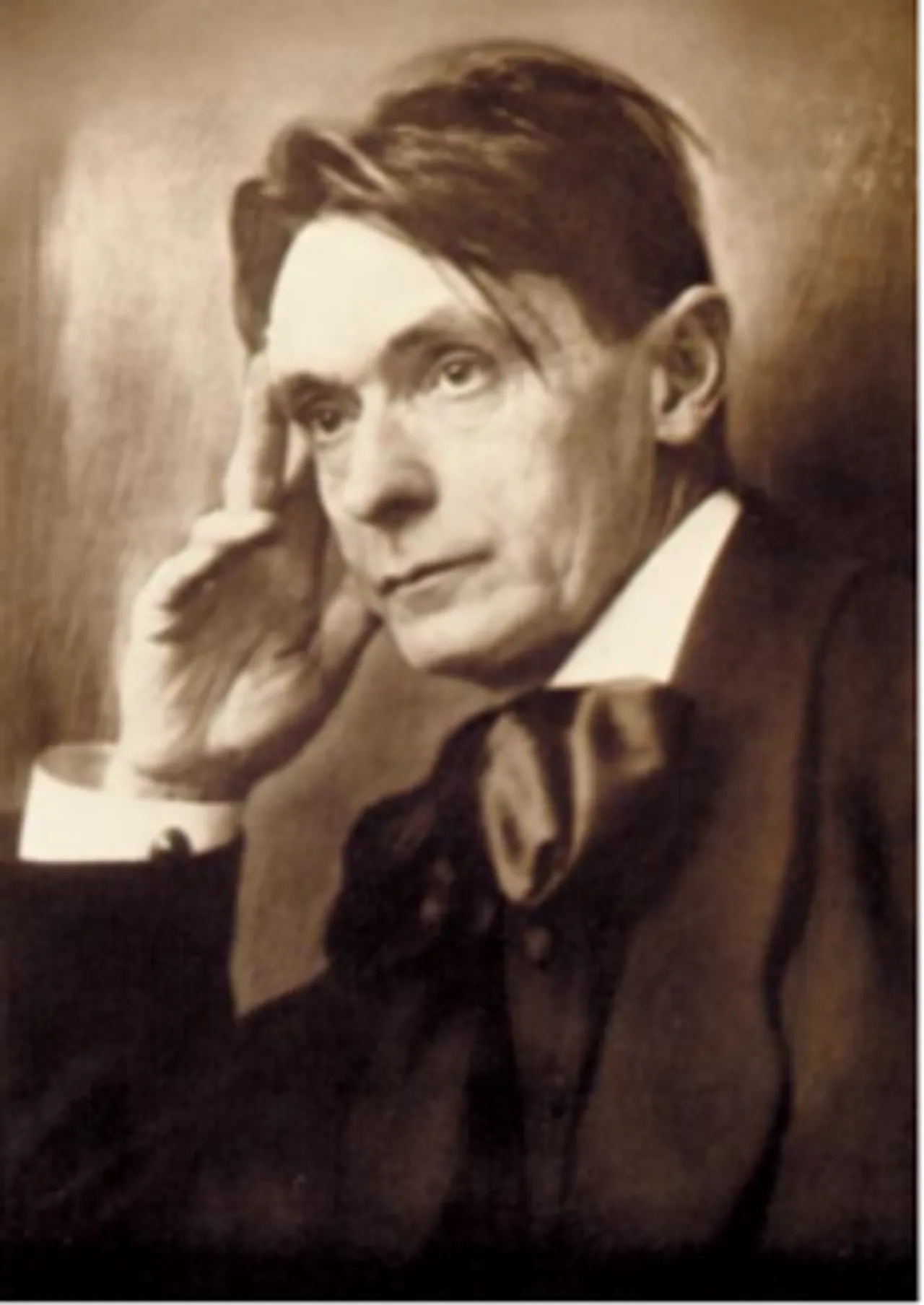
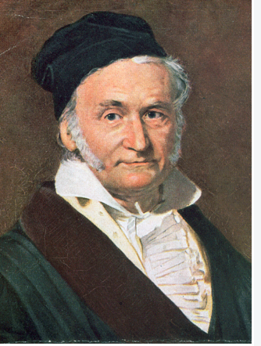
Trailblazers: Rudolf Steiner (1861- 1925) and Carl Friedrich Gauss (1777- 1855)
The mathematician, Gauss kept his most radical discoveries secret in a notebook because he feared the controversy they would cause among contemporary mathematicians.
What were some of these discoveries?
Gauss discovered one form of non-Euclidean geometry, hyperbolic geometry which in the twentieth century Einstein would use to develop his theory of relativity. Gauss also developed the Fast Fourier Transform (FFT) algorithm in 1805 to calculate asteroid orbits which was rediscovered by Cooley and Tukey in 1965. He also predicted the exact return of the lost dwarf planet Ceres, pioneering modern statistical prediction long before computers.
The polymath, Rudolf Steiner, was also engaged by non- Euclidean geometry and saw its potential for understanding the life-world, a discovery the world is still catching up with.
Except Steiner turned not to hyperbolic geometry, but to projective geometry and recommended it as a main lesson in year 11. The eminent mathematician, Morris Kline, wrote an article about it for the Scientific American in extolling its virtues in the field of pure mathematics:
“In the house of mathematics there are many mansions and of these the most elegant is projective geometry. The beauty of its concepts, the logical perfection of its structure and its fundamental role in geometry recommend the subject to every student of mathematics.”
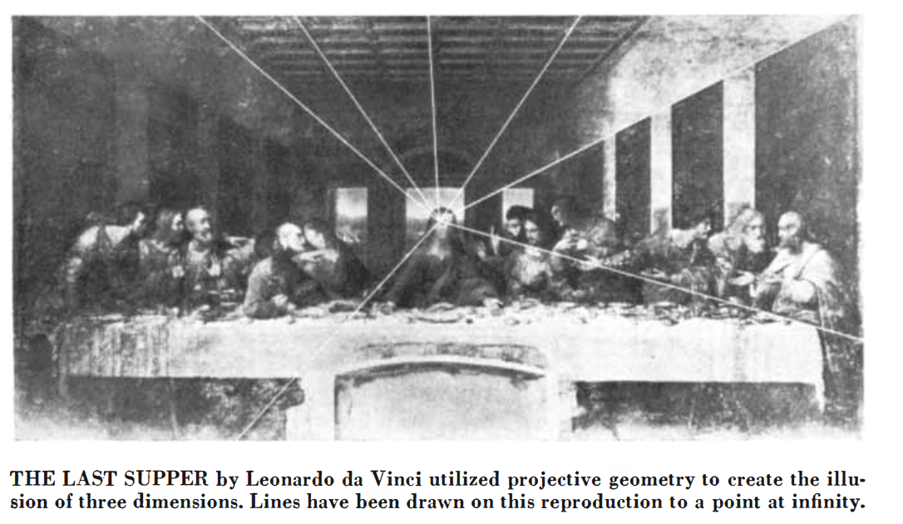
Kline further explains its origin in art:
“Renaissance painters created it to represent three-dimensional reality in two dimensions. Their invention finally transcended Euclidean geometry and today forms an integral part of physics”
This story has continued to the present day. The German mathematicians following Steiner’s indications were content to stay with projective geometry in the abstract, but mathematicians working in England and later Australia have worked hard to see how projective geometry can extend our understanding of living organisms particularly with respect to their form. The first of these was George Adams (1894-1963), a post- graduate student at Cambridge University. When he objected to the atomism and materialism of his time, he was advised by the philosopher Bertrand Russell to study projective geometry. Later after meeting Steiner, Steiner advised him to continue these studies and look for links to the life world. A student of Adams, Lawrence Edwards (1912-2003), a maths and class teacher at the Edinburgh Steiner school, dedicated 30 years to research and published in this area – The Vortex of Life (1992) and Projective Geometry (2024). He was able to map changes in the form of plant buds and the human heart, leading to the idea the living beings grow in a field of form.
This research was picked up and extended in Australia by John Blackwood (1940- 2015), a mathematics teacher at Glenaeon and an independent researcher, in his book Geometry in Nature: Exploring the Morphology of the Natural World through Projective Geometry (2012). More recently Sophia Montefiore, has developed the visual art aspect of Projective Geometry and contributed to the pedagogy with two books, The Art of Projective Geometry (2023), one for teachers and one for students.
A major part of the main lesson is doing exact mathematical drawing. Rediscovering the theorem and relationships through seeing the patterns emerge on the page. Students come to appreciate more deeply the underlying beauty underlying the natural world.
Neil Anderson
College of Teacher’s Chair,
English, Maths and Geography Teacher