
The Canberra Times article featuring Orana, and the use of student images in response to eSafety Commissioner’s recommendations
By Sally Pryor
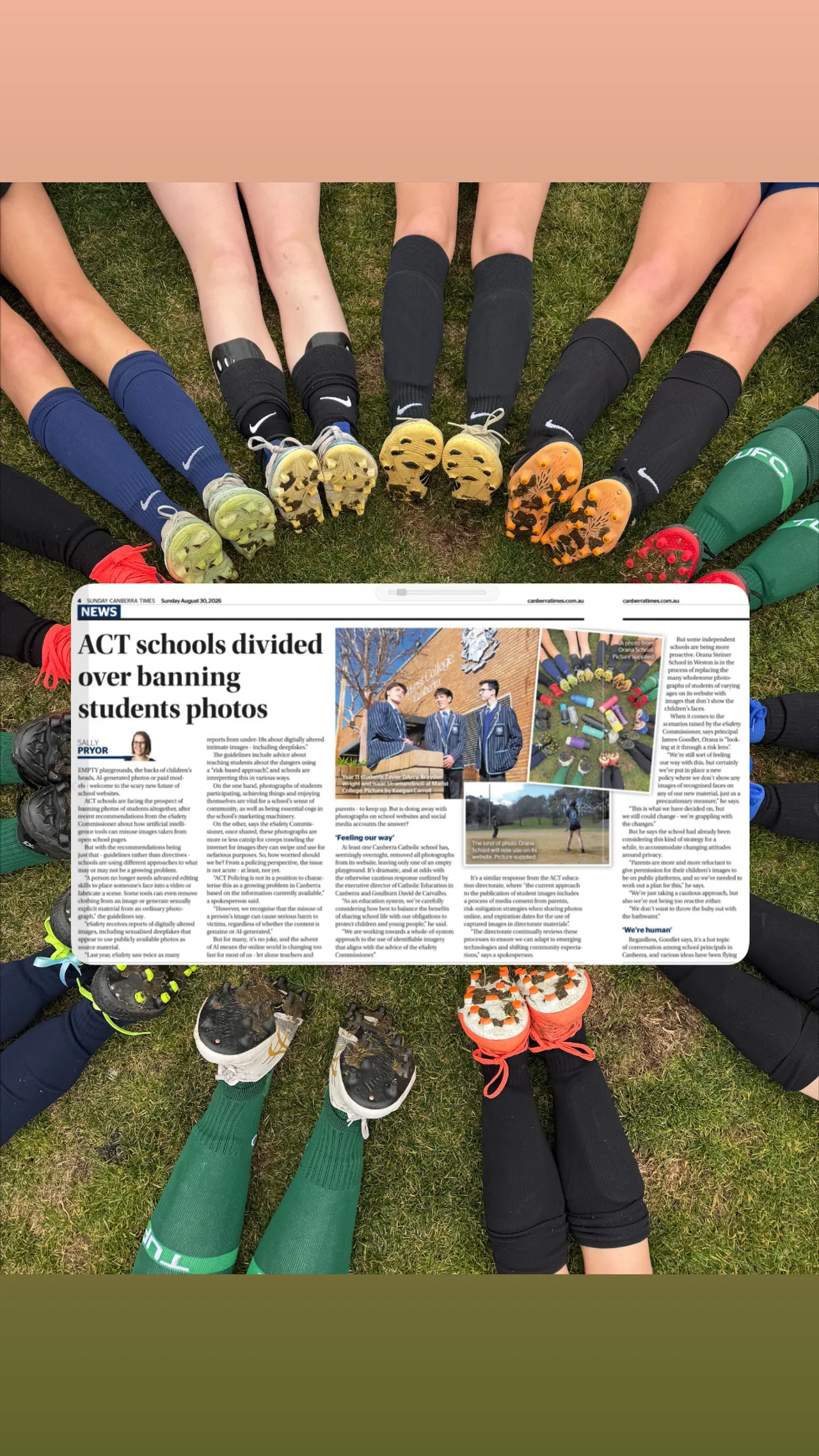
A Canberra school has removed all photos of students from their website. Why?
By Sally Pryor
Updated August 30 2026 - 10:24am, first published 5:30am

Empty playgrounds, the backs of children's heads, AI-generated photos or paid models - welcome to the scary new future of school websites.
ACT schools are facing the prospect of banning photos of students altogether, after recent recommendations from the eSafety Commissioner about how artificial intelligence (AI) tools can misuse images taken from open school pages.
A Canberra school playground. Inset: children wearing football studs in a circle and girls holding hands. Pictures by Gary Ramage, Orana Steinar School, Shutterstock
But with the recommendations being just that - guidelines rather than directives - schools are using different approaches to what may or may not be a growing problem.
"A person no longer needs advanced editing skills to place someone's face into a video or fabricate a scene. Some tools can even remove clothing from an image or generate sexually explicit material from an ordinary photograph," the guidelines say.
"eSafety receives reports of digitally altered images, including sexualised deepfakes that appear to use publicly available photos as source material.
"Last year, eSafety saw twice as many reports from under-18s about digitally altered intimate images - including deepfakes."
The guidelines include advice about teaching students about the dangers using a "risk-based approach", and schools are interpreting this in various ways.
On the one hand, photographs of students participating, achieving things and enjoying themselves are vital for a school's sense of community, as well as being essential cogs in the school's marketing machinery.
On the other, says the eSafety Commissioner, once shared, these photographs are more or less catnip for creeps trawling the internet for images they can swipe and use for nefarious purposes.
So, how worried should we be? From a policing perspective, the issue is not acute - at least, not yet.
"ACT Policing is not in a position to characterise this as a growing problem in Canberra based on the information currently available," a spokesperson said.
"However, we recognise that the misuse of a person's image can cause serious harm to victims, regardless of whether the content is genuine or AI-generated."
But for many, it's no joke, and the advent of AI means the online world is changing too fast for most of us - let alone teachers and parents - to keep up.
But is doing away with photographs on school websites and social media accounts the answer?
'Feeling our way'
At least one Canberra Catholic school has, seemingly overnight, removed all photographs from its website, leaving only one of an empty playground.
It's dramatic, and at odds with the otherwise cautious response outlined by the executive director of Catholic Education in Canberra and Goulburn David de Carvalho.
"As an education system, we're carefully considering how best to balance the benefits of sharing school life with our obligations to protect children and young people," he said.
"We are working towards a whole-of-system approach to the use of identifiable imagery that aligns with the advice of the eSafety Commissioner."

A photo from Orana School. Picture supplied
It's a similar response from the ACT education directorate, where "the current approach to the publication of student images includes a process of media consent from parents, risk-mitigation strategies when sharing photos online, and expiration dates for the use of captured images in directorate materials".
"The directorate continually reviews these processes to ensure we can adapt to emerging technologies and shifting community expectations," says a spokesperson.
But some independent schools are being more proactive.
Orana Steiner School in Weston is in the process of replacing the many wholesome photographs of students of varying ages on its website with images that don't show the children's faces.
When it comes to the scenarios raised by the eSafety Commissioner, says principal James Goodlet, Orana is "looking at it through a risk lens".
"We're still sort of feeling our way with this, but certainly we've put in place a new policy where we don't show any images of recognised faces on any of our new material, just as a precautionary measure," he says.
"This is what we have decided on, but we still could change - we're grappling with the changes."
But he says the school had already been considering this kind of strategy for a while, to accommodate changing attitudes around privacy.
"Parents are more and more reluctant to give permission for their children's images to be on public platforms, and so we've needed to work out a plan for this," he says.
"We're just taking a cautious approach, but also we're not being too reactive either.
"We don't want to throw the baby out with the bathwater."
'We're human'
Regardless, Goodlet says, it's a hot topic of conversation among school principals in Canberra, and various ideas have been flying around, including relying on AI-generated photographs of children, or even paying child models to appear in promotional materials.
Over at Marist College in Pearce, deputy headmaster Liam Stakelum finds this notion horrifying.
"We're a Catholic school, so we believe that we're created in the image of God, and I'm not going to give all that kind of spiel, but we're human," he said.
"When we start putting up non-humans as a risk mitigation strategy, I think the world's gone crazy."
He says the eSafety recommendations were unexpected, but Marist, an all-boys Catholic school, is not making any drastic changes.
"We're not panicking like other schools, but we do need to consider it," he says.
"I think schools have got to look at it from a risk point of view, and absolutely, I'm concerned about where the technology is going, and the potential uses of it.
"I haven't seen it demonstrated that it has been such a problem that we need to go to those drastic efforts just yet."
He said he's far more focused on ensuring the students know how to use social media and understand what's not appropriate.
"The items that would create offence would come to us very quickly," he says.
"Certainly, we've got policies about things like teachers, for example, and our boys are told very clearly that our teachers are off-limits.
"We'll get a boy that might take a teacher photo and put it up on TikTok. There's quite a good one of me actually, with lasers coming out my eyes. But that's always happened, do you know what I mean?"
Stakelum doesn't want to appear dismissive, but he prefers to look at the potential problems within the school's own systems, rather than worrying about what might be happening out in the ether. And he can see that the problems that might arise are far more acute for girls than boys.
"I guess we come from more within our own context. We haven't had that many issues with boys using photos in an inappropriate way - that's not really a high behavioral problem for us."
And unlike at Orana, he says the number of Marist parents who opt out of allowing student photos is shrinking.
"Most parents aren't necessarily as concerned with that as they used to be, and I think that's probably just how social media has spread throughout the world anyway."
'A whole new world'
But perhaps we're all being naive. Deputy director of the multi-institutional research group Australian Cybercrime Observatory Tim Cubitt says the risk is all too real, and it's growing.
"I think when it comes to protecting young people, the messaging is unfortunately appropriate from the eSafety commissioner, especially when we don't fully have the totality of the risk profile understood at the moment," he says.
"I'm trying to convey to people that this is a whole different environment. It's not like someone has to hack into your social media and get photos that you've saved. It's people going and finding publicly available photos or semi-publicly available on a social media profile, and manipulating them, and so that is a different way of thinking about this type of offending."
As a parent, he says, he finds the whole notion that otherwise innocent photos are now considered dangerous incredibly unfair. But based on what he sees through his research, kids are in clear and present danger.
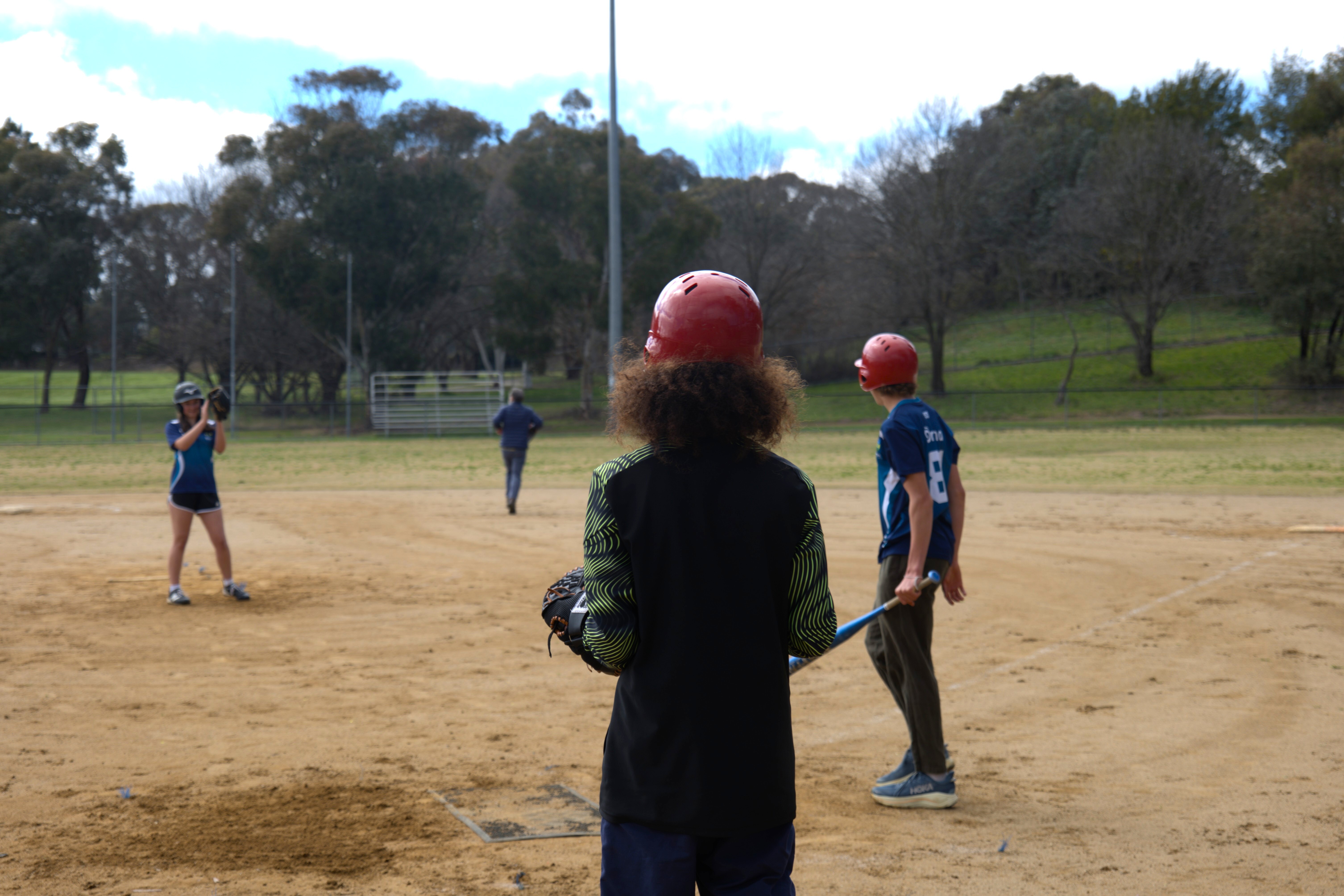
The kind of photo Orana School will now use on its website. Picture supplied
"Our research has shown recently, and really consistently, that about 15 in every 100, so 15 per cent of people under 18, experience online sexual victimisation, and when that involves the non-consensual sharing of sexual images, more than one in four cases involve AI.
"That's a lot, and this is partly what the eSafety commissioner is talking about. It's that there's a whole new opportunity that's been opened up to victimise children. It's not just a case of sexual solicitation of imagery that's then shared non-consensually, or sending a nude across a text message or an encrypted app that then is shared non-consensually onwards, which is how we would historically have known those offenses to happen.
"Now it's a case of, you're friends with someone on Facebook or you follow someone and they follow you back on Instagram. You can access their photos and digitally manipulate them and notify them and share that onwards.
"Or in the case of schools, if a school were to post a picture of some of their students, the ability to digitally manipulate those photos using AI into nude photos and things like this - this is where it becomes a whole new world."
Martin Stonebridge is waging a one man campaign against ACT speed signs near schools.
He says in this period of uncertainty, the messaging from the eSafety commissioner should, at the very least, encourage these conversations between schools and parents, and with young people whose lives are so deeply integrated with the online world.
"If it goes in one direction, we can look back and go, 'Oh, thank goodness, that was a bit silly. We overreacted'," he says.
"If it goes in the other direction, we might find ourselves saying, 'Well, thank goodness we reacted in such a strong way because that could have been way worse than it was'".
"Speaking as a researcher and human, I'd rather be a little bit cautious until we know."